
Our Framework
The SHARPLY Framework
Everything in a business is interlinked — sales feeds finance, finance constrains production, production depends on people. SHARPLY is how we look at all 7 of those pieces together, instead of fixing one and being blindsided by another.
7 Pillars 4 Foundations
Funding Strategies
The 7 Pillars
Everything rises and falls with leadership. But leadership needs to see the whole business.
There are many aspects to a business — from sales and marketing to backend systems, from people to R&D. At SUT Consulting, we’ve distilled it down to 7 key aspects every leader needs to keep in view. We call it SHARPLY.
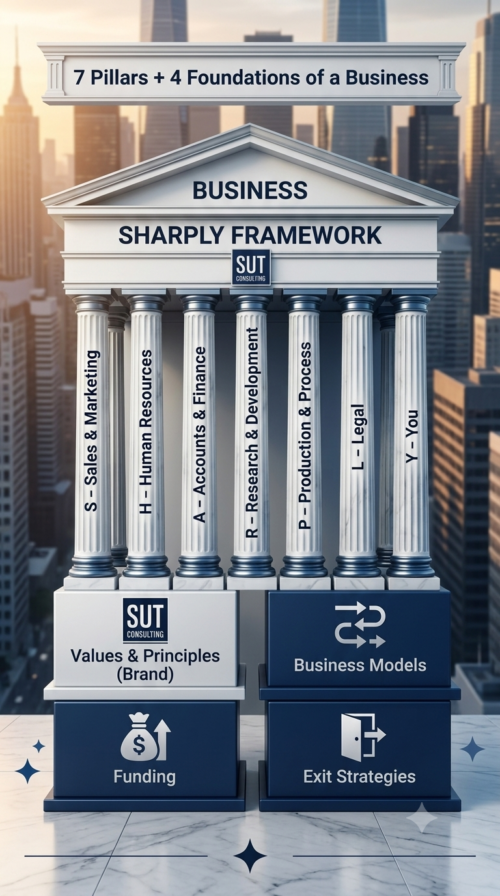

SALES & MARKETING
How the business generates demand and converts it — the engine that funds everything else.

HUMAN RESOURCE
The people, culture and structure that determine whether the rest of the plan actually gets executed.

ACCOUNTS & FINANCE
Cash flow, margins and financial visibility — where most “sudden” crises are actually months in the making.

RESEARCH & DEVELOPMENT
How the product or service itself keeps improving, instead of quietly falling behind.

PRODUCTION & PROCESS
The operational backbone — how consistently the business can actually deliver what it sells.

LEGAL
Contracts, compliance and the exposure most founders only think about after something goes wrong.

YOU
Business Foundation Framework
Beyond the 7 pillars — the foundation underneath them.
SHARPLY tells you where to look. These four areas are what we help build underneath it: what the business stands for, how it actually makes money, how its leader plans to eventually exit, and how it gets funded along the way.
01 — Brand
Principles & Values
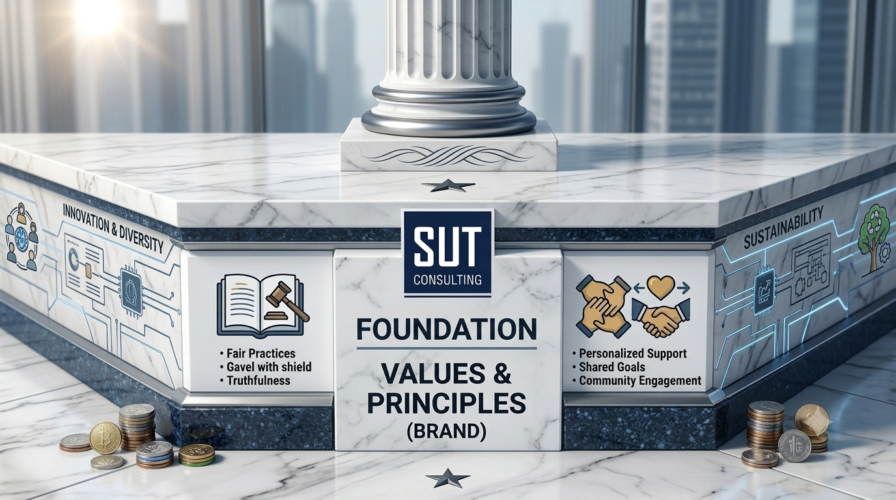
Every customer is bombarded with advertising. What keeps them coming back isn’t the ad — it’s whether they recognise themselves in what your business stands for. That recognition is your brand, and it’s built on principles and values, not a logo.
The question we ask early in an engagement: if a customer had to describe what your business stands for in one sentence, would they get it right?
01 — Brand
Principles & Values
Every customer is bombarded with advertising. What keeps them coming back isn’t the ad — it’s whether they recognise themselves in what your business stands for. That recognition is your brand, and it’s built on principles and values, not a logo.
The question we ask early in an engagement: if a customer had to describe what your business stands for in one sentence, would they get it right?
02 — Business Models
Business Models
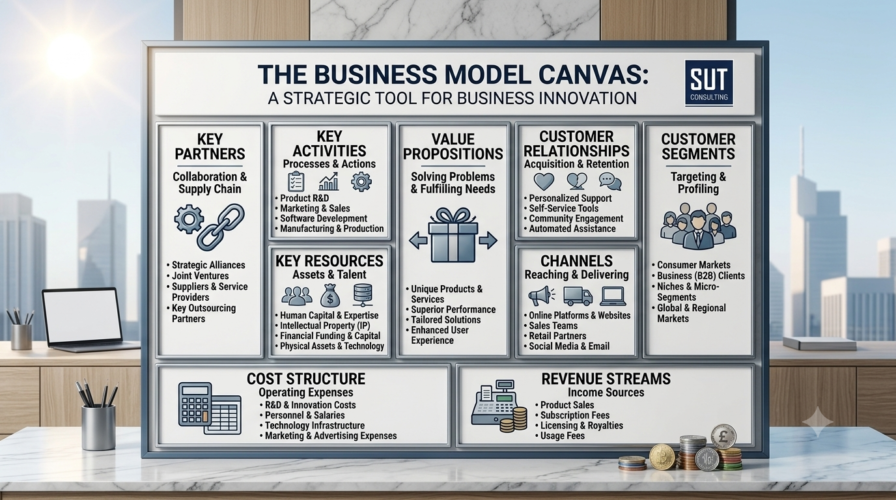
A business model is simply how a company makes money — separate from the marketing ideas that shift year to year. The classic example is Hewlett-Packard: the money was never really in the printer, it was in the ink cartridges sold for years afterward.
A business model comes down to four things: who you serve and why (customer value proposition), how you profit from it, what resources you need to deliver it, and what processes keep it running.
03 — Exit Strategies
Plan Your Exit Before You Start
Some entrepreneurs build to sell. Others build a legacy meant to last. Neither is more correct — it’s your business, your call. What matters is deciding early, because the choice shapes how you run the business long before the exit itself.
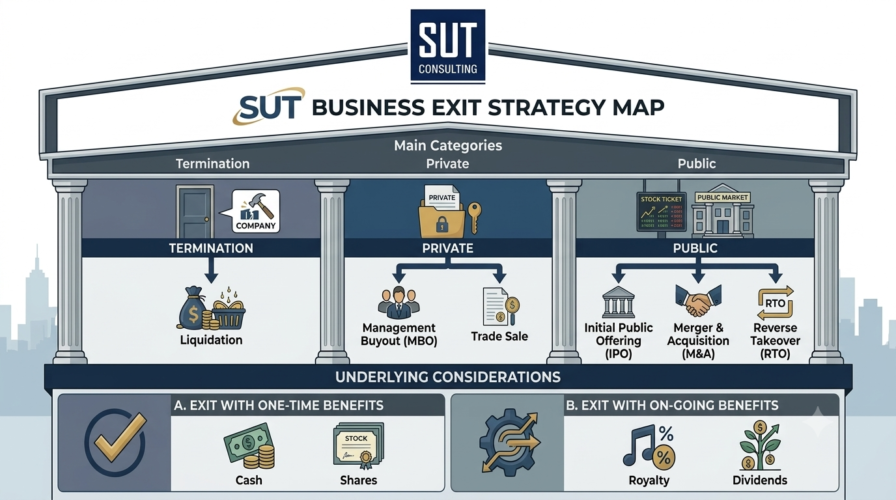
We map exits into two broad outcomes: a one-time cash benefit (trade sale, termination, liquidation) or an ongoing benefit through shares (IPO, M&A, RTO, royalty or dividends) — each with its own underlying considerations.
03 — Exit Strategies
Plan Your Exit Before You Start
Some entrepreneurs build to sell. Others build a legacy meant to last. Neither is more correct — it’s your business, your call. What matters is deciding early, because the choice shapes how you run the business long before the exit itself.
We map exits into two broad outcomes: a one-time cash benefit (trade sale, termination, liquidation) or an ongoing benefit through shares (IPO, M&A, RTO, royalty or dividends) — each with its own underlying considerations.
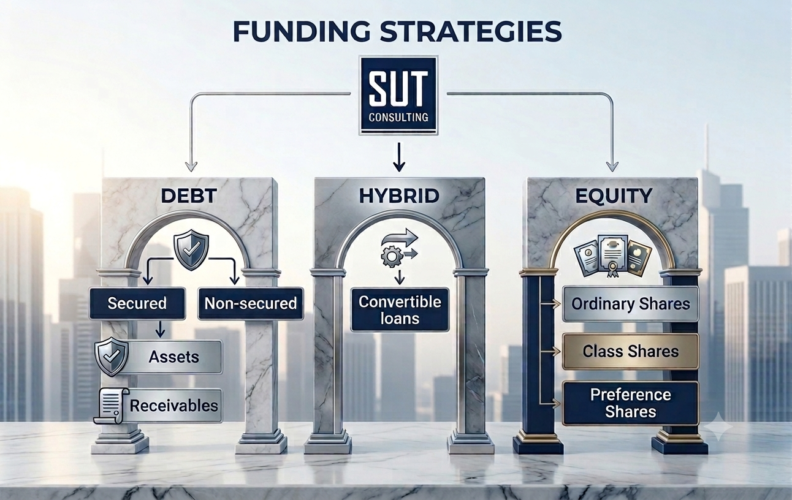
04 — Funding
Funding
Every business needs funding, and it’s usually the entrepreneur’s own money that starts it. As the business scales, most founders eventually need OPM — Other People’s Money. If a public listing is on the roadmap, planning the funding path early matters even more.
We map the routes into three types: Equity (ordinary, class or preference shares), Hybrid (convertible loans), and Debt (secured against assets or receivables, or non-secured).
Let's map your business across all 7 pillars.
A SHARPLY review is usually the first step in any engagement — it’s how we find out where to focus before we touch anything else.